
 September 17, 2026
Why the Room Spins When You Roll Over in Bed: Understanding BPPV (Positional Vertigo)
Written by Dr. Joseph Adams, D.C., M.S. (Applied Clinical Neuroscience)
If you've ever rolled over in bed, looked up at a shelf, or bent down to tie your shoes and suddenly felt like the entire room was spinning, you're not alone.
For many people, these brief but intense episodes are caused by Benign Paroxysmal Positional Vertigo (BPPV). BPPV is an inner ear condition where tiny calcium crystals drift out of place and settle into one of your balance canals, sending false movement signals to your brain. The result is short, intense spinning triggered by specific head positions. It's one of the most common causes of vertigo and dizziness.
The good news is that when it's correctly identified, BPPV often responds very well to specific treatment.
What Causes BPPV?

Inside your inner ear is an incredible balance system made up of tiny fluid-filled canals that detect head movement. These canals work alongside small calcium carbonate crystals, called otoconia, that normally sit in another part of the inner ear called the utricle, where they help detect gravity and linear movement.
Sometimes those tiny crystals become dislodged. When that happens, they can drift into one of the balance canals where they don't belong. Every time you move your head in certain directions, the misplaced crystals move through the canal and send inaccurate information to your brain about your body's position.
Your eyes, brain, and inner ears suddenly disagree about where you are in space.
The result? A brief but intense sensation that the room is spinning.
What Are the Symptoms of BPPV?
People with BPPV often notice symptoms when they:
- Roll over in bed
- Lie down or sit up
- Look up toward a ceiling
- Bend over to pick something up
- Turn their head quickly
The spinning sensation usually lasts less than a minute, often only 10 to 30 seconds. But it can leave you feeling nauseated, unsteady, or anxious about moving your head afterward.
Many patients begin avoiding certain movements because they're afraid of triggering another episode. That avoidance is understandable, and it's also one of the reasons BPPV is worth addressing rather than working around.
When Dizziness Needs Emergency Care
The word "benign" in BPPV means it isn't life-threatening. But not all dizziness is benign.
Call 911 or go to the nearest emergency room if dizziness comes with any of the following: sudden severe headache, double vision or vision loss, slurred speech, weakness or numbness in the face, arm, or leg, trouble walking or severe imbalance, fainting, chest pain, or new hearing loss. These can be signs of a stroke or another condition that needs immediate attention.
Why Does the Affected Canal Matter?
Not all BPPV is the same.
Your inner ear contains three different balance canals on each side: the posterior, horizontal, and anterior semicircular canals. Displaced crystals can end up in any one of them, and each canal requires a different treatment approach.
The posterior semicircular canal is involved in the large majority of cases. When crystals become trapped there, they create a very predictable pattern of dizziness during specific head movements. That predictability is exactly what makes an accurate evaluation possible.
Providers identify the canal using positional testing, most commonly the Dix-Hallpike test, which places your head in a specific position while your eye movements are observed. The pattern and direction of those eye movements tells us which canal is involved and which side.
This is why the evaluation comes first. Treating the wrong canal, or assuming every case of vertigo is the same, can leave symptoms unchanged or even make them worse.
How Is BPPV Treated?
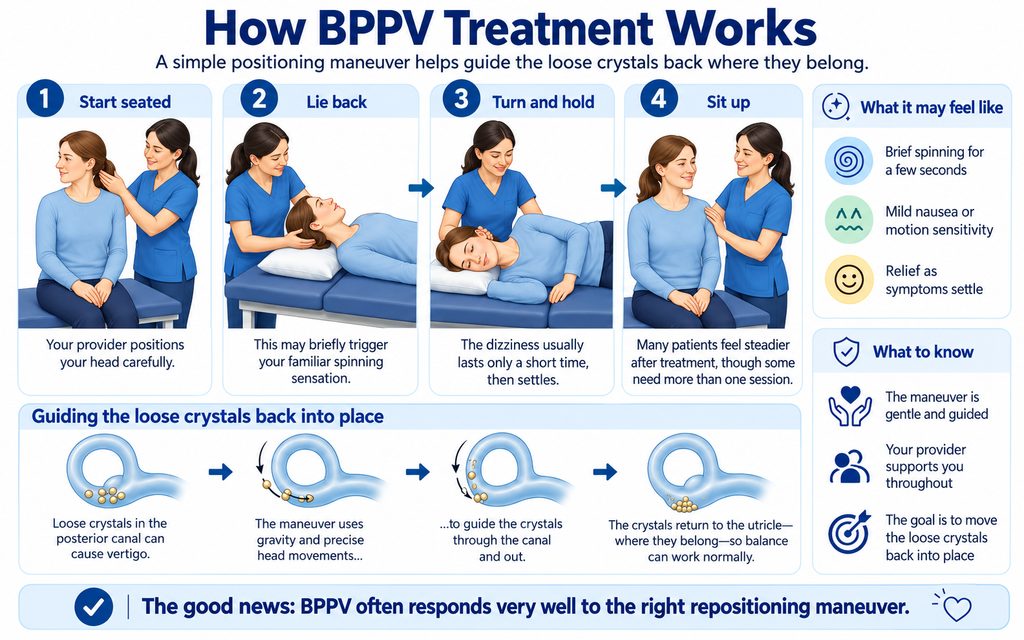
Unlike medications that simply mask dizziness, BPPV treatment focuses on correcting the underlying mechanical problem.
Using carefully guided repositioning maneuvers, known clinically as canalith repositioning, a trained provider uses gravity and specific head positions to move the misplaced crystals back to the part of the inner ear where they belong. The Epley maneuver is the best known of these and is used for posterior canal BPPV. Other canals call for different maneuvers.
These maneuvers are gentle, precise, and based on which canal is involved.
We want to be clear about the evidence here, because we don't say this about everything: canalith repositioning for posterior canal BPPV is one of the best-supported treatments in all of vestibular care. When the diagnosis is right, the results are often fast and dramatic.
Many people experience significant improvement after a single session. Others, particularly those with crystals in more than one canal or with additional balance issues layered on top, may need multiple visits. Individual results vary.
A note on home maneuvers: We understand the appeal of trying the Epley yourself after watching a video. We don't recommend it as a first step. A home maneuver assumes you already know which canal is involved and which side. If that assumption is wrong, you can move crystals into a different canal and end up feeling worse than when you started. Identifying the canal first is what makes the maneuver work.
Can BPPV Come Back?
Yes, and we'd rather you hear that from us now than be surprised by it later.
BPPV recurs in a meaningful number of people, sometimes months or years after successful treatment. A recurrence doesn't mean the first treatment failed or that something is wrong with you. It usually means a crystal has come loose again, and it typically responds to treatment the same way it did the first time.
When Dizziness Isn't BPPV
Although BPPV is very common, not every episode of dizziness is caused by displaced crystals.
Conditions such as vestibular migraine, vestibular neuritis, persistent postural-perceptual dizziness (PPPD), concussion, cervicogenic dizziness, and certain neurological disorders can create similar symptoms while requiring very different treatment approaches.
Some of these overlap. It's entirely possible to have BPPV and something else going on at the same time, which is one reason a repositioning maneuver alone sometimes doesn't deliver the full relief people expect.
That's why a thorough examination comes before treatment, every time.
You Don't Have to Keep Living With It
Many people spend months, or even years, thinking dizziness is simply something they have to live with.
If your symptoms are being triggered by specific position changes, there's a good chance there's an explanation that can be identified through the right evaluation.
At Calibration Brain and Body in Mansfield, we perform detailed vestibular and neurological assessments to determine whether BPPV is truly the source of your dizziness and, if it is, which canal is involved so treatment can be as precise as possible.
If you've been experiencing spinning with head movements, you don't have to keep bracing for the next episode. Getting the right diagnosis is the first step toward feeling steady again.
Ready to find out what's actually causing your dizziness?
Schedule an evaluation or call us at (817) 779-3435.
Calibration Brain and Body
408 South Main Street, Suite B
Mansfield, TX 76063
We see patients from Mansfield, Arlington, Grand Prairie, and Midlothian.
Frequently Asked Questions
How long does BPPV vertigo last?
A single episode usually lasts less than a minute, often 10 to 30 seconds. The spinning stops on its own once your head is still, though nausea and unsteadiness can linger longer than the spinning itself.
Can BPPV go away on its own?
Sometimes. BPPV can resolve without treatment, but it may take weeks or months, and there's no reliable way to predict who will resolve quickly. A repositioning maneuver often resolves it considerably faster.
Is BPPV dangerous?
The word "benign" means BPPV isn't life-threatening. The main risk is falling during an episode. That said, dizziness has other causes that are serious, which is why an evaluation matters before you assume you know what you're dealing with.
Can BPPV come back after treatment?
Yes. BPPV recurs in a meaningful share of people, sometimes years later. If it returns, it usually responds to treatment again.
Should I try the Epley maneuver at home?
We don't recommend it as a first step. Home maneuvers assume you already know which canal is involved and which side. If that's wrong, you can move crystals into a different canal and feel worse. An evaluation identifies the canal first.
What does BPPV feel like?
Most people describe a brief, intense sense that the room is spinning, triggered by a specific movement: rolling over in bed, lying down, sitting up, looking up, or bending over. Between episodes, many people feel completely normal.
This article is for educational purposes and is not a substitute for an in-person evaluation. Individual results vary. Dr. Joseph Adams is licensed by the Texas Board of Chiropractic Examiners.